
 .
.
 .
.

.
.


… another image from my vintage photograph collection of DOGS AND THEIR HUMANS.
I want to know… Who is this girl all dressed up in her finest? And the poodle-esque pup displayed on a pedestal, what is his/her name? When and where did they live? And what became of them?
“A photograph is a secret about a secret. The more it tells you, the less you know.”
— Diane Arbus

Because Jigs says so…


Romano and Lolo, the happy couple.

By Karen Elizabeth Land — originally published in “The Great Falls Tribune” and “The Kansas City Tribune,” July 2010.
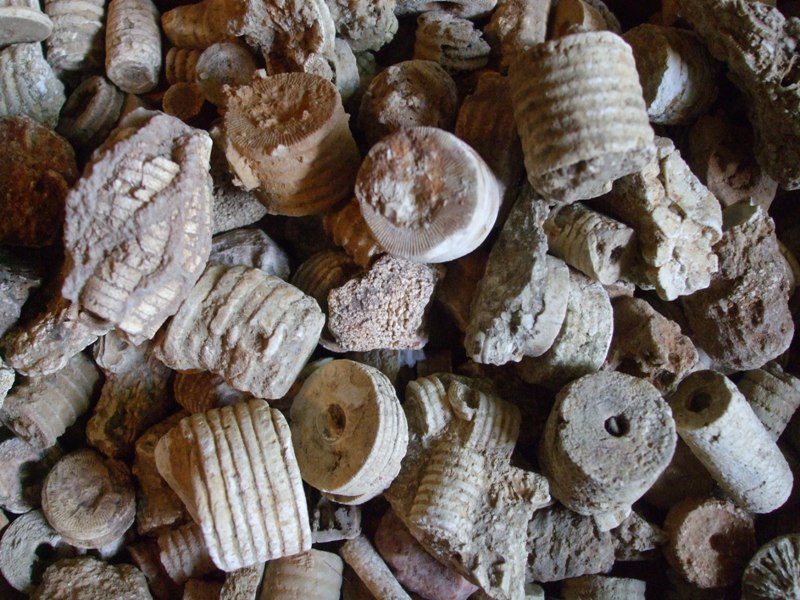
The small wooden treasure chest stored in my childhood closet holds a collection of fossilized sea animals that could be as old as 250 million years old. Whenever I’m home, I pull the heavy box from the shelf dumping the contents across my bedspread to find my favorites. My first few years out of high school, I was crazy about crinoids. I spent my days off of jobs at the local veterinary hospital and hardware store traipsing the shallow streams of southern Indiana with my dog, Kirby, searching for the columns of round “buttons.”
I know very little about fossils. But when I stumbled across my first crinoid while on a hike, I was drawn to their perfection. The stems of crinoids have a dependable shape; I trained my eye to find the fossilized discs interlocked tightly together like a stack of coins.
My crinoid collection wouldn’t wow the scholars. I have never found an entire specimen in 3-D relief. My treasure chest is full of bits and pieces – mostly chunks from the stems of individual crinoids. According to Crinoids and Blastoids by Susan H. Gray, ancient crinoids looked like flowers with roots, stems, and petals, but were actually sea animals that moved and gathered food. Thousands of different varieties of crinoids are now extinct, but several hundred still exist today. Modern crinoids, rarely seen by humans, are known as sea lillies and feather stars. All crinoids belong to the echinoderm group which includes modern animals such as sand dollars, sea stars, and sea urchins.
Indiana is a hot bed for spectactular crinoid finds. “The first crinoid calyx collected from the Crawfordsville, Indiana area was by 9-year old Horace Hovey in 1842, who was collecting ‘encrinites’ along the banks of Sugar Creek to sell,” www.fossilmuseum.net explains (and shows photographs of magnificently-preserved assemblages). When I pick a tiny fossilized stem from the siltstone, I can’t wait to get it home to show someone, anyone. I can just imagine young Horace’s excitement when he struck crinoid gold.
Crinoids became my specific obsession because they are one of the most commonly found fossils in the world. You can find crinoids everywhere – along roads, creeks, farmland, and mountainsides in many different states. The July 1953 addition of the Journal of Paleontology states, “thirty-two species of crinoids, distributed among 22 genera, are recognized in the Lodgepole (Mississippian, Kinderhookian) fauna of Montana.” This included the Little Belt Mountains, Big Snowy Mountains, and Tobacco Root Mountains.
Everytime my dog and I made the roadtrip to the dense forests of southern Indiana, I’d bring home at least a few fossils. We’d spend the day walking the watersheds, picnicing in the shade, and lounging in the grass, dozing off in the mid-day sun to the sounds of a rippling stream. My little treasure chest of fossils brings those memories rushing back. Fossils aren’t just about appreciating the vast and elaborate history leading up to “ME.” Searching for fossils is the perfect way to enjoy the present. Going on an outdoor adventure always puts me back into the place I need to be – the here and now.

.
I am a collector of vintage dog books and photographs. Since I arrived back in the city of Indianapolis, I’ve been having a difficult time walking four dogs on leashes and taking photos of our adventures all at the same time. So… sitting in my office yesterday, I looked up and saw some of my framed, antique images on the wall and hard-bound, first editions on the shelves and thought they might be interesting to share with fellow dog and history-lovers.
In 2005, I purchased this photograph at the wonderful Second Edition Bookstore (http://www.secondeditionbooksbutte.com/) in Butte, Montana. No information came with it other that a note penciled on the back reading, “Grandmom’s Dad,” which I assume correlates with the X above the second man from the right. I love everything about this scene: the men and woman dressed up in old, yet formal garb posing on a snow-packed mountain somewhere at high elevation, and the dog handler kneeling below the group with a string of working dogs that appear to be maybe Samoyeds.
Who are these people? Exactly what is the breeding of these dogs and what are they being used for? Who is the one woman in the photo? Where did they come from? And where did they go after this photo was taken? Who is the photographer? And how did this photo get to a used bookstore in Butte, Montana and then end up in a writer’s suburban Indianapolis home?
Life is a string ~~~ we are all connected.

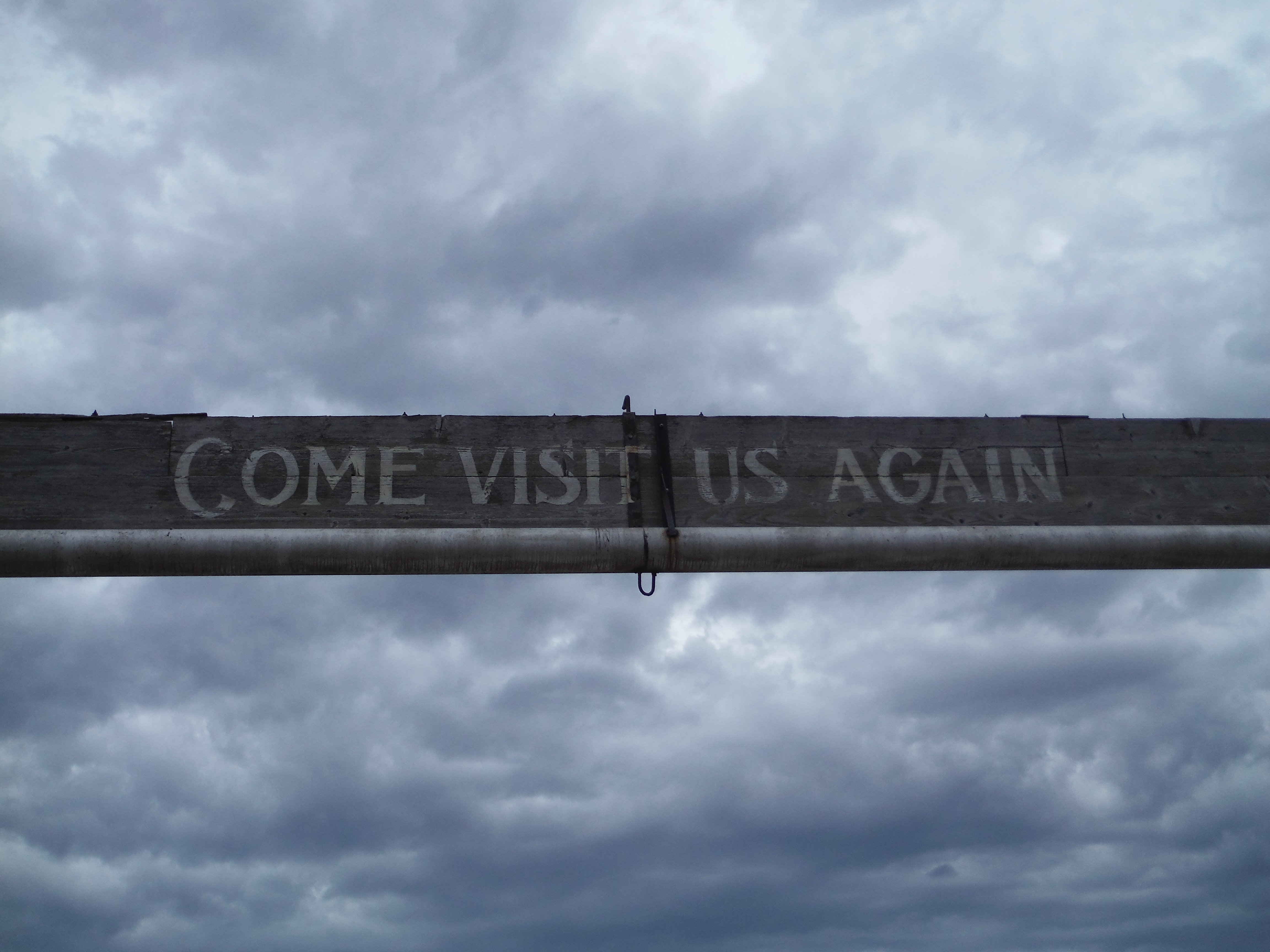
Harlowton, Montana Fairgrounds
1) Fact: On August 16th, I loaded my string of dogs (Jigs, Chloe, Lolo, and Romano) and gear into my Toyota Ravioli and hit the highway headed for Indiana. I was sad to leave Montana in the middle of a perfect Big Sky summer, but knew I had many things to do back “home.” At age 43, I have spent half my life in Indiana and the other half in Montana. Some days when I feel divided between two places, I remind myself how lucky I am to have two homes with people I love at both ends… I guess this also fits into the good fortune category.

Crow Fair 2014
2) Good fortune: On our road trip, I cut through the Crow Nation, rounded a bend, and witnessed a stunning sight — a white-capped sea of teepees rose up from the rolling Montana grasslands. I had stumbled upon the 96th annual Crow Fair, one of the largest modern day American Indian encampments in the nation. Over 1500 teepees are erected near the Little Big Horn River each year, making the Crow Fair “the teepee capitol of the world.” Next year, I plan to return to watch the pow-wow, parade, and rodeo. Plus, I really want to see the Indian Relay. After watching the gorgeous Independent Lens documentary, Indian Relay, on PBS, I would love to experience the horses, riders, and action firsthand. Go to http://www.pbs.org/independentlens/indian-relay/ to learn more, and click on WATCH VIDEO to view the 55-minute documentary for free.
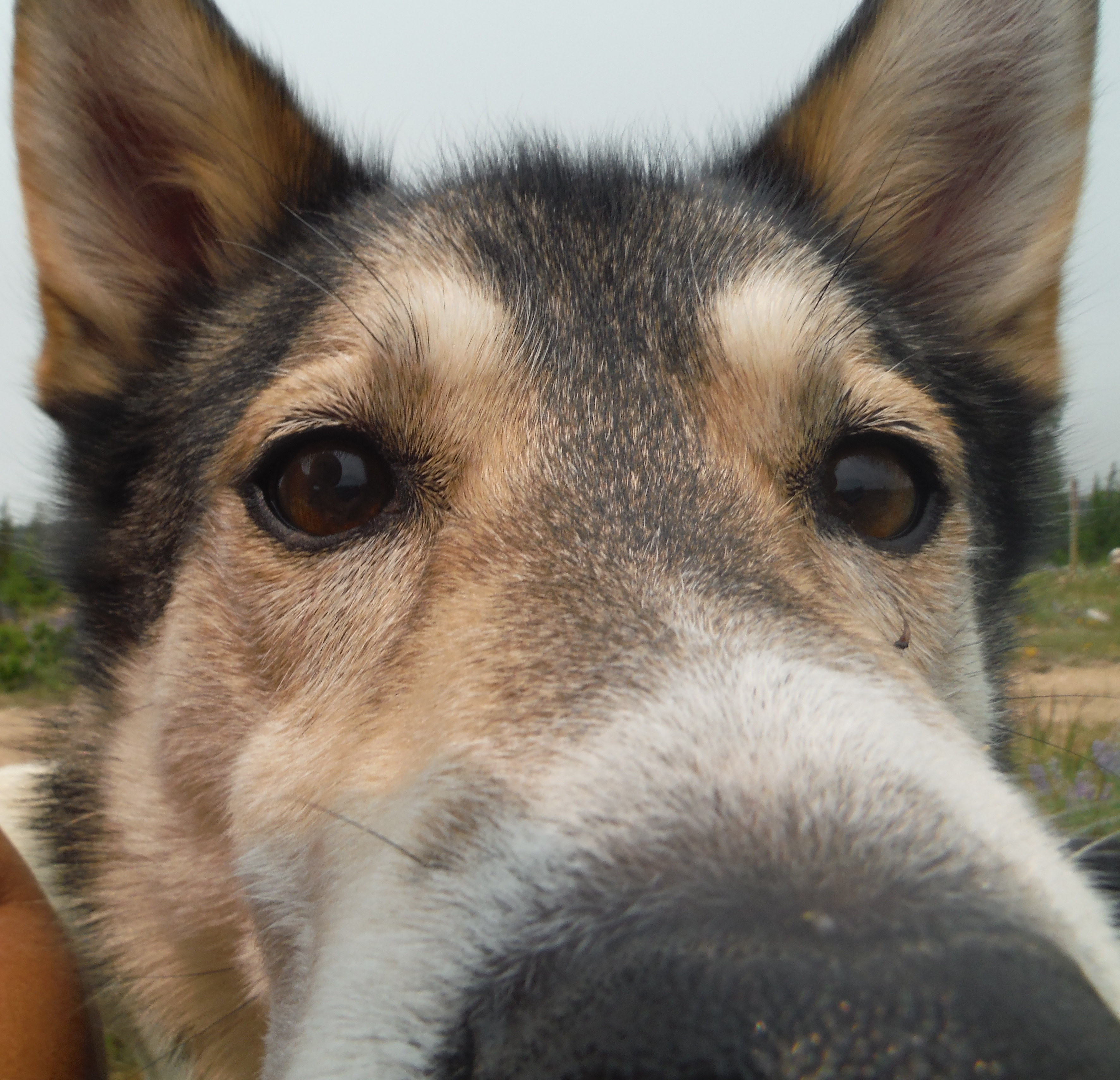
Romano… a dog with too many opinions
3) Fact: Romano, the new edition to our string, often howls when I tune my car radio to classical or country music stations. I have yet to determine if this means he really likes classical and country… or he can’t stand classical and country. My other three dogs are silent in the vehicle — you wouldn’t even know they’re in the back seat unless you turned around. Romano attempts to harmonize to the music, and talks to me when he thinks it’s time to stop for a walk. If he wasn’t so cute, he’d be very annoying.

Indiana sunset
3) Fact: After putting another 1800 miles on Ravioli, the String and I crossed the Indiana line on Tuesday evening. Indy was having an unseasonably cool summer until we pulled into town. Now it is in the 80’s with high humidity. The daily lightning and thunder storms have been intense. Romano lets me know hours in advance that weather is moving in… the poor guy goes manic running laps around the yard, whining, trembling all over, and trying to climb the gate. Thankfully, I know that when the temperature drops low enough, he’ll always calm down if I let him sit in Ravioli — Romano loves his car. I leave the windows wide open (even if it’s raining), and have two Ryobi fans blowing on him to keep him cool and also add some soothing white noise. When it’s cold enough, I’ll try a Thundershirt on him.
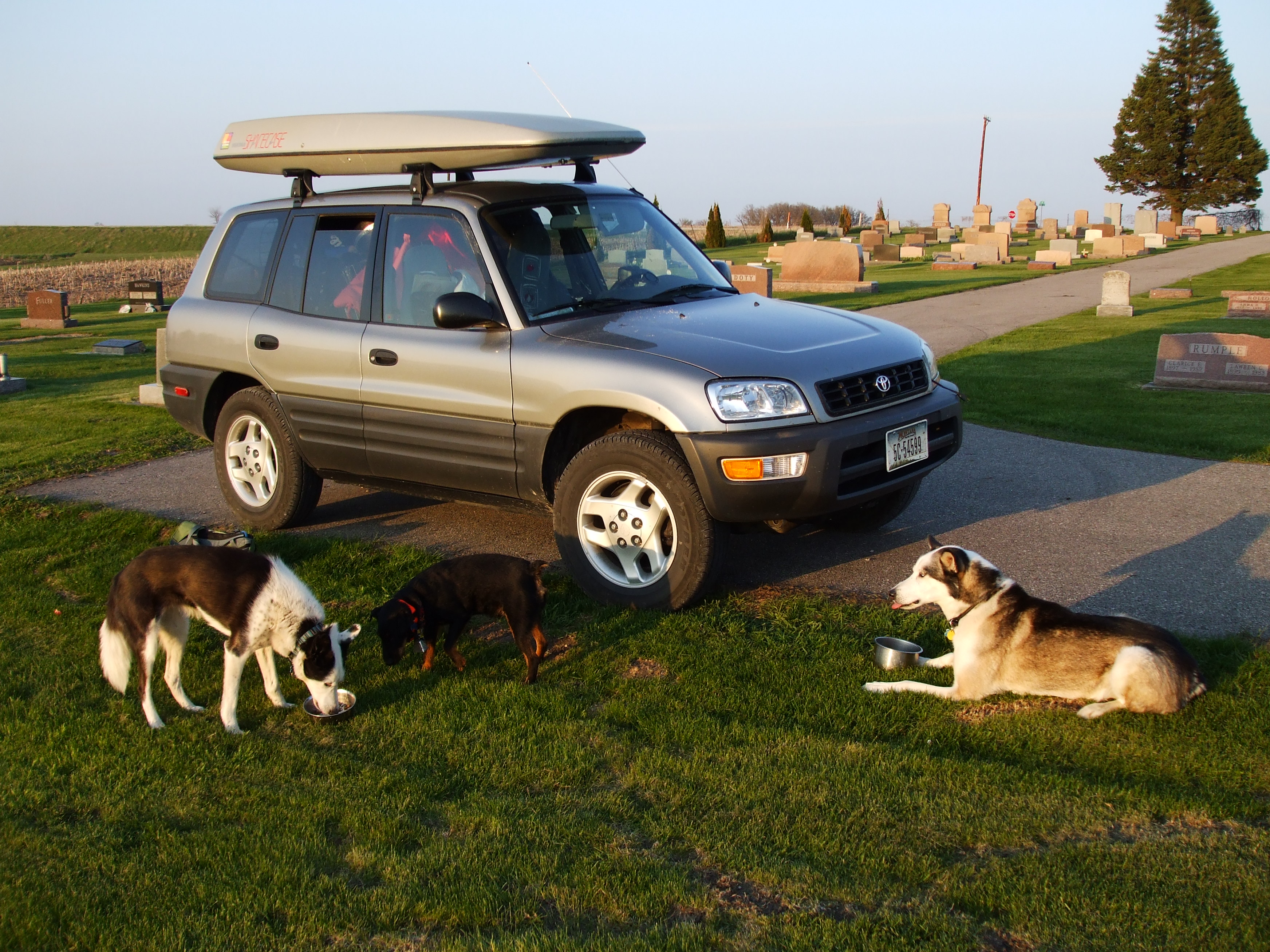
At only 150,000 miles, the Toyota Ravioli, parked at a cemetery in Kansas, was just a toddler in this photo. Pig, my brilliant Iditarod lead dog, is on the left, Jigs in the center, and Borage to the right. Pig and Borage now travel with the String in spirit…
4) VERY good fortune: My beloved 1999 Ravioli waited until after our 1800-mile road trip was over to blow a leak in its original radiator. When I pulled into a restaurant just miles from my Indy home, I noticed coolant spraying from the front of the vehicle. I couldn’t help but laugh, feeling so fortunate this did not happen in the middle of South Dakota. And then the next day, as if to reinforce how lucky I really am, I got a flat tire on my way to the mechanic!?! I tried to remove the car jack so I could change the tire, but the bolt holding the car jack in place under my seat was rusted tight (I usually carry a larger jack but took it out of the Rav in MT because I had no spare room). A can of Fix-A-Flat given to me as a going-away present by a friend saved the day. I inflated the tire and drove a few miles to Indy Tire for a patch job. The man who worked at the front counter said, “I’ve never seen someone with a flat tire so happy.” And I was happy… feeling oh, so fortunate to be in the right place at the right time once again. They repaired the 3-month old tire, and used a large wrench to loosen the frozen bolt on the jack, oiling the threads so it will be ready when I need it again. Just as I pulled away from Indy Tire, the Great Ravioli’s odometer rolled over to: 276,000 miles.


.
Anyone who has ever road-tripped with Karen Land knows that he or she will probably end up wandering around at least one cemetery per day. I have explored cemeteries in every state except Hawaii (anyone game?), and I keep a logbook of where I’ve been and some of my favorite grave monuments and markers. Yesterday, I revisited one of my favorite headstones anywhere. In August 1993 on my very first drive across the country as I was headed to Missoula to attend the University of Montana, I stumbled across this beautiful memorial at Butte’s Mount Moriah Cemetery. Buried at this spot are J. Frank Beck (1834-1909) and Agnes Reid Beck (1846-1933) along with Frank’s Faithful Dog. Pictured below is my mom, Janice, with My First Faithful Dog, Kirby. Kirby was with me when I discovered this stone. That following spring when my mom came for a visit, I took her to Butte to tour the historic mining town, eat burgers and chocolate milkshakes at Matt’s Place (opened in 1930, Montana’s oldest drive-in restaurant), and to see Frank and His Faithful Dog. Anyone who has ever owned a good dog can appreciate what this memorial represents…


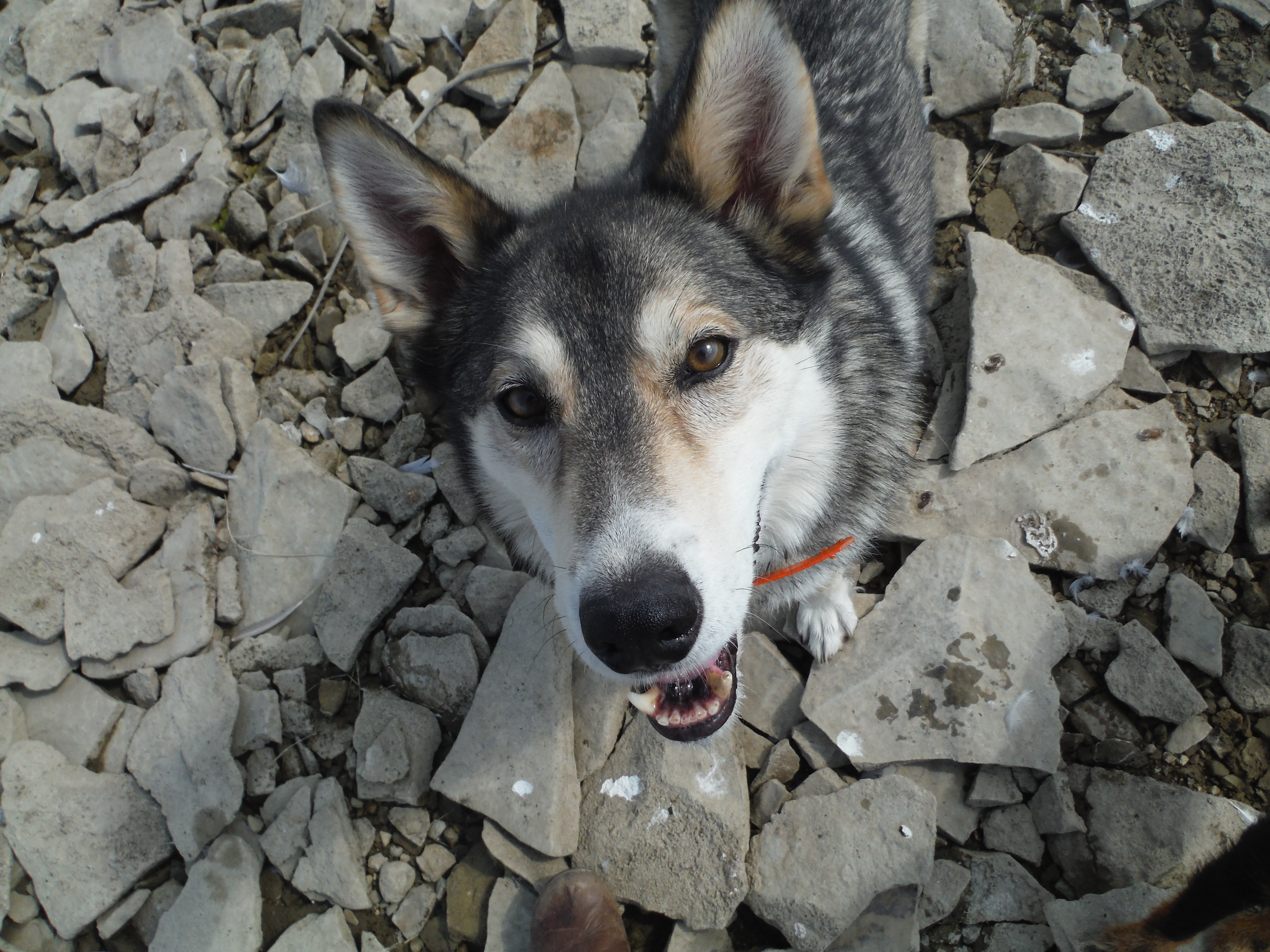
It’s hard to believe that Romano, Bachelor #1, has been visiting with our string for a month now. I knew that trying to blend a “new” dog in with our well-established pack would be an experience full of ups and downs. I was tempted to write about the process as it unfolded, but I didn’t want my blog-published words to somehow set Romano’s fate. One day a new dog can seem like an angel dropped down from Heaven to remind you to live in the moment and keep you laughing. And the next day that same dog can seem like the devil incarnate, ransacking your once peaceful life with K9 neuroses and demands. After raising and training literally hundreds of sled dogs, I was prepared for the inevitable dramas — jealousies, bullying, resource-guarding, toy-hoarding, fights over anything from a rotten fish to a plush bed. Terry Adkins, my mushing mentor, and I always titled these soap opera moments: “As the Kennel Turns…”
Romano, known on this blog as Bachelor #1, was from the “cheese” litter. Born in 2003, I decided to name this family of eleven Alaskan Huskies after one of my favorite foods. Romano’s siblings were: Nacho, Colby, Cheddar, Jack, Gouda, Muenster, Tillamook, Whiz, Goat, and Stinky. This entire string of cheese was a joy to train, run, and race. I called them my hippie huskies — a completely laid-back bunch, they tail-wagged their way down rough trails and through many a Big Sky blizzard. When it came time for me to take a break from the 24/7 mushing lifestyle, I was fortunate to find the perfect new musher-parents for Whiz, Romano, and Stinky. Kristi and Dwight Gilliland of Billings, Montana, adopted them in 2007, often referring to the trio as The Cheese Brothers.
Looking out the window right now, I’m reminded of how often life loops back around on itself. Romano, now 11 years old, knows it’s going to be a hot afternoon. Lolo is lounging on her couch (a round, waterproof Cabelas dog bed that cost more than the 1970’s davenport I’m sitting on now), watching her cheese man excavate a trench big enough for two under the shade of the lilacs. Later on today, I will glance out the window and, most likely, discover them both stretched out like lazy lions in the cool dirt, dozing with their tail-ends touching.
But just two weeks ago, I was prepared to return Romano to Kristi. Bachelor #1’s presence was doing exactly what I hoped it would — making my lonely, heart-broken Lolo happy again — but there were other “issues.” Taking a sled dog from a larger kennel where he feels secure and part of a pack and moving him to an unfamiliar place is like escorting Crocodile Dundee through New York City. Romano had the perfect sled dog life as part of Kristi and Dwight’s string, and without his Cheese Brothers and the rest of their team, he feels vulnerable. Common things startle him. Strange people and noises — a flag flapping in the wind, children giggling, hip hop thumping from a car stereo — send him into a panic.
But I also knew the fix wasn’t as simple as returning Romano to his pack. Originally, Kristi thought Stinky would be the best match for the grieving Lolo and my mobile lifestyle. But sadly I never got the chance to try him out — a week before I was to pick him up, he started limping around the kennel. A soft muscle tumor was found on his back leg, and Kristi, knowing it was right to end his pain, was forced to put her sweet Stinky to sleep.
So, feeling it was best for Whiz to stay in a familiar place because he is losing his eyesight, Kristi called me up and asked, “Want to try out Romano?”
Visiting with Romano at the Gilliland’s home, I was thrilled to discover he’s still the same hippie husky I knew and loved 7 years earlier. But when I took him and my string for their first walk together in public at Livingston’s Sacajewea Park, Romano suffered a mental melt-down. Walking along a narrow dirt path sandwiched between a road and a steep, wooded bank dropping down into the Yellowstone River, Romano started off with typical sled dog enthusiasm, driving forward until he hit the end of my extendo-leash, and then leaning hard into his harness and dragging me down the trail like we were headed to Nome. I was thrilled to see my group settle into a natural line-up: Romano leading the way, Chloe staying right at his heels, Jigs trotting along like he’s competing for Best-of-Show at Westminster, followed by the keeper-of-the-kibble (me), and then, finally, Lolo (my 2004 Iditarod LEAD DOG… she declared retirement years ago).
What a fine string, I was thinking to myself at the exact moment a runner charged up the embankment, turning onto the trail, heading towards us. When Romano saw a human wearing a baseball cap, black sunglasses, and purple spandex charging directly at him, he shifted in reverse so fast I didn’t have a second to respond. He scurried backwards, running over Chloe, around Jigs, past me and Lolo until he hit the end of the extendo-leash in the opposite direction. But Romano didn’t just stop there, he thrashed about until he peeled the harness over his shoulders and head, and then once free, he fled for his life, running as fast as he could away from the woman jogger who didn’t slow down until I pleaded, “Please, STOP! He thinks you’re chasing him!”
“Why does he think that?” Romano’s purple predator asked me, but I didn’t have time to answer. By this point, Romano had already leaped down the hill, disappearing into the heavy brush along the Yellowstone River. My mind raced, imagining Romano dead on the road, or disappearing into the heart of a strange town, never to be found again. He doesn’t even know me, I thought, thinking of the 7-year lapse in our relationship.
It’s a natural instinct to want to chase a dog who’s running away from you, but I decided right at that moment I just needed to STOP. It was a difficult thing to make myself do, but I kneeled down in the middle of the path. My other three dogs, confused by my strange behavior, were thrilled to have me at eye level, and they danced and circled around me until I was hog-tied by three 18-foot leads. I sat there and waited for what seemed like forever, my eyes locked on the empty trail ahead.
And then… finally… Romano popped his head out of the tall weeds. He looked up the trail and saw no one. And then he looked back down the trail and saw me parked there, bound and practically gagged by the rest of my string. Lifting his head high, his expression lit up with recognition. He bounded towards us at full speed, slamming his 66-lb. body straight into the middle of the pack.
I wish I could say this first stressful experience with Romano/Crocodile Dundee was my last. But Romano continued to have major panic attacks in public. And Lolo’s nervous nature was wearing off on him, making him even more leery of the outside world. I didn’t let that stop me though. Wanting to socialize him, I walked him at city parks in Bozeman, Livingston, White Sulphur Springs, and Harlowton. I made him sit and watch kids making crafts at a summer camp. The poor boy was miserable the entire time, worried that all of these miniature humans — with their endless laughter and screams — were out to murder him with dreamcatchers. That’s when I called Kristi and said, “I don’t think it’s going to work…”
I felt miserable making the decision to send Romano back. I knew he loved our hikes in the mountains. And he lives for daily car rides in the Rav just like my beloved Borage once did. Lolo and him were working out as companions, even sleeping together in the same Dogloo at night. And to my amazement, even Jigs seemed to enjoy his company. I was prepared for the usual fights over food and deer legs and my attention, and they never happened. Yet still, knowing how much I travel, Romano’s fear of the big new world seemed like a deal-breaker. I didn’t want to torture the old man.
The day after I decided to send Romano back to Kristi’s kennel, I took him and the rest of my string out to the Martinsdale Reservoir. On a whim, I decided to let him run free for the first time ever (on purpose). Much to my surprise, I unclipped his leash and he stayed right with me, trotting a few yards ahead but then turning around to make sure I was still there. My heart sank even lower. How can I return such sweet dog?
The next day I went to Livingston to shop, and I stopped at Sacajewea Park to take the dogs on a quick walk-about. Something came over me, and I decided to let Romano go loose. Walk yourself… I told him as I released him from the back of the Rav. He paused and looked straight at me before he jumped out of the car, and then he trotted off down the trail, leading the string towards our favorite spot — an active osprey nest along the Yellowstone River. Moving so easily down the busy path, it took me minutes to realize what was happening. Romano was watching everything — bikers on the road, hikers on the trail, rafters in the river — but he wasn’t freaking out. Processing it all at a comfortable distance and his own pace, I witnessed him growing braver by the moment.
A few days later out on the Martinsdale reservoir, Romano stood on the rocky beach and stared at a fishing boat. With his head held high and his pointy ears pricked forward, he examined the bizarre object trolling across the lake; he listened to the voices of the boat’s occupants, the muffled laughter carrying so far across the water. I sat down next to him on a smooth slab of stone and waited. After 10 long minutes, Romano finally turned his attention from the curious object and looked straight in my eyes. “That’s a boat…” I told him. He pushed his big head into my lap and wagged his tail. And then he turned away from me, loping off to catch up with the rest of my string — with the rest of his string.

… with a bag of treats!


 String of Dogs