
Excerpt from “String of Dogs” by Karen Land —
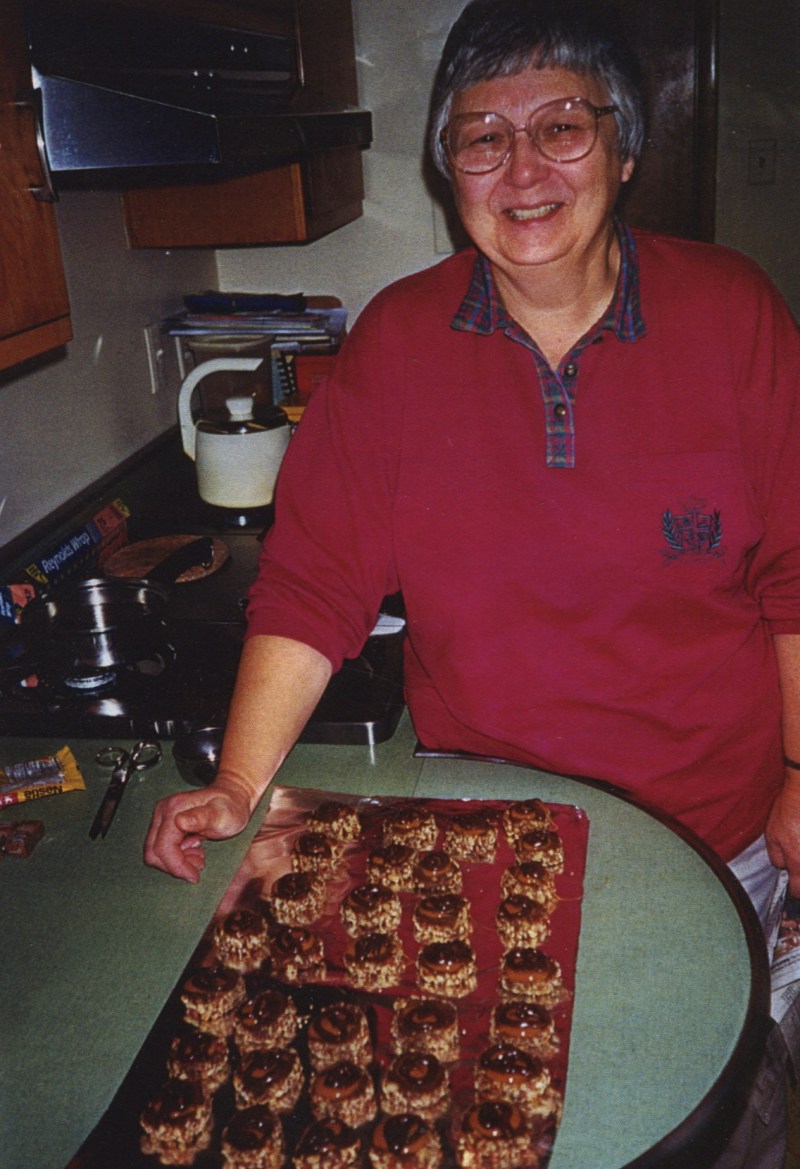
Janice Land with some of her famous Christmas treats
*****
We feed those we love. “Are you hungry?” For 39 years, Mom always made my favorite: French toast loaded with melted butter, sprinkled with powdered sugar, drowning in warm, maple syrup. Every single day, several times a day, she cooked our meals, fed the entire family.
Dave and I fed the dog.
Dad fed the wild birds. With the precision and care of a pharmacist, he measured cups of striped sunflower seeds and millet from coffee cans into the feeder, hung a fresh suet cake from the maple tree, and rinsed and filled the birdbath with clean water. Then he came back inside, poured another bourbon over ice, sat down in his chair by the window, and waited for the rush of winged creatures—nuthatches, cardinals, chickadees, wrens, woodpeckers, and gold and purple finches—to swoop down from the sky and accept his offerings. Be well, grow strong, fly. I never heard him say such things to anything or anyone, but I imagine that’s how he felt as he watched his beloved birds gather at his table to feed.
—–
Little Belt Mountains, Montana
“Dinner anyone?” Sixteen sets of glowing eyes pierce the darkness, and stare at me. Moving by the light of a headlamp, I pull the cooker from my bag, position it close—but not too close—to the sled, pour a few bottles of Heet alcohol into the bottom pan, and retrieve a box of “windproof” matches from an anorak pocket. “Wah-woo…wooo…woooo,” Bandit talks to me as I work. I don’t look up; I must stay focused on the task of cooking dinner for my dog team at 20 degrees (F) below zero. “Wah-woo, wooo, woooo.” Bandit is full of advice. “Okay, goofball, you know it takes awhile,” I remind him, knowing he won’t bed down until his belly is full.
Damn wind. I huddle over the cooker, using my body and the sled as a shield, and pull off a mitt, then a glove. With fingers as stiff as pencils, I attempt to pick one tiny match from the box and strike it on a zipper. A tease of fire flashes, then disappears, swallowed up by the wind. “Wah -woo, wooo,” Bandit cries.
I try again. And again. Between each attempt, I shove my hands inside my beaver mitts until I feel my fingertips throb back to life. Keep trying. During a random pause (one moment of calm among the fury), I strike my tenth match. A thin flame meets alcohol and erupts into a blaze. “Yes!” I yell out loud. “Ladies and gentlemen, we have fire.” My audience, even Bandit, remains silent. Sixteen huskies watching, waiting.
It takes a lot of snow to make a little bit of water. I pack the metal pot to the lip and place it on top of the fire. I keep adding snow by the scoopful until finally, 30 minutes later, I have enough liquid for 1 human and 16 dogs. I fill my own Thermos and pour the rest of it in a 5-gallon insulated bucket.
Beaver. I dump 8 pounds of beaver chunks from a burlap bag into the hot water and screw the lid back on the bucket. Next, I line out 16 bowls, scooping 2 cups of dry dog food into each one. Then I toss one vitamin E and two fish oil capsules on top of the kibble. I turn my face away as I remove the lid. A thick, rank steam rises from the bucket. I stir the bloody beaver soup and then ladle one helping over the top of the dry food in each bowl. “Dinner is served!”
Every dog attacks his or her meal except for Viper. She places one paw on the edge of her bowl and flips it upside down, picking out the pieces of softened beaver and letting the precious liquid and kibble freeze on the snow-packed ground. “I’m sorry, I forgot,” I tell her. I dump the water from my own Thermos into her empty bowl. She drinks the clear water. Viper doesn’t eat food mixed together; nothing can be touching. She wants plain water in one bowl, dry dog food in another, and her meat served on the ground.
I lie back on my sled, pop open the tin of homemade cookies I received in the mail the day before, and read the note. “Treats for my musher. Stay warm. Merry Christmas. Love, Mom.” I flip off my headlamp and my small world turns immense. Trillions of stars, alive and glittering, hang just out of reach above me. With frost-nipped, bloodstained fingers, I devour date pinwheels, Spritz cookies, Santa shortbread. The wind is gone. I hear my kids lapping up beaver soup from their bowls. Be well, grow strong, fly…
—–
Cold sleep. I am a tiny, shivering being at the core of a Matryoshka nesting doll. Cocooned inside a pod of goose down, zipped up in a canvas gear bag, nestled in the bed of a dog sled, and sheltered by a stand of Ponderosa Pine, a curtain of dark clouds wraps around this frozen mountain, and just beyond, a whorl of constellations envelops all.
Snow falls.
But I do not know it.
—–
“Do birds ever sleep?” I am a little girl sitting on the back step with my dad in the dark. He drinks his bourbon, smokes his pipe, stares out at nothing. Thump, thump, thump… a woodpecker chisels away on the giant maple. “Every living being needs rest,” Dad says. He takes a puff of his pipe. “But wild animals sleep with one ear open. They can never let their guard down.”
—–
In this cramped black womb, I rouse from a brief but deep slumber. I glance around. Where am I? I am blind. I have no arms, no legs, no body. My heart races. It is difficult to breathe. I shift and hear the wispy crinkle of nylon. I reach out. My hands push into tight walls above me, below me, on all sides. Where am I? I knock into something: my headlamp. I flip on the light. And find myself again.
Outside they hear my movements, sense my panic. One single deep-voiced husky throws out a long, low howl in response. That one dog starts it and then another and another join in until my entire team is singing at the top of their lungs like they’re in the church choir. Except they don’t sing any religious hymn. They deliver something wild, something straight from their souls. The ghostly serenade undulates, rising and falling like ocean waves, until what seems like the middle of the tune all 16 dogs simultaneously stop singing.
Silence.
I wait. I listen. I hope for another round. But they are done. We drift back to sleep. One ear open.
—–
My life, my breath, frozen into a million shimmering crystals on the inside of my sled bag. I jerk on the zipper. A shock of sunlight and snow tumble together through the opening, covering me. I stand up in the bed of my toboggan and look around. Everything I know—my team, my gear, the entire mountainside—is gone, erased, draped in white. Only beauty remains.
Every living being needs rest. Safe and warm under a swathe of fresh powder, I let my dogs sleep.




 String of Dogs